
I have managed to avoid putting on VR goggles for years now, even when students have opted to use them for their final Imaginer l’avenir ADST inquiry projects. I inherently dislike the idea of putting on goggles and escaping from the world around us. While I have heard friends and colleagues endorse VR and AR wholeheartedly for both learning and entertainment, I’ve so far used every trick in the book to avoid this technology, short of asking to go to the bathroom when the librarian pulls the goggles out. I felt it was finally time to embrace AR….
First things first: what is Augmented Reality? How does it differ from Virtual Reality (VR)? Green, Green and Brown (2017) offer the following definition:
Augmented reality (AR) is the interaction of overlaid audio,
graphics, text, and other virtual elements on a real-world
environment displayed in real-time.
The authors note that what distinguishes AR from Virtual Reality (VR) is that AR blends virtual interfaces with the physical world, whereas VR is a completely immersive and simulated experience (Green Green and Brown, 2017).
A simplified definition of AR is offered by Mohan (2015) in Khoshnevisan & Le (n.d.) as “any technology that inserts digital interfaces into the real world”. How then could this technology support language learning in the library? Generally speaking, the benefit of AR is that it can allow students to enhance the physical classroom environment by bringing in virtual elements to the physical space. This can be achieved through the use of cameras on devices that present digital media to students through using things such as QR codes and other camera-activated technology tools. An example that comes to mind that I have experienced is at the Bateman Gallery downtown, where a QR code scan in one of the galleries brings up an audio clip of bird songs connected to the birds in the paintings. Walking through this small gallery is a unique experience where the bird songs augment the physical experience of viewing the paintings.
AR in the language learning classroom could involve scanning a symbol or code in the classroom and connected to a video, audio or other digital text. Classroom examples of AR can be texts created by others, or videos or recordings created by the students. Scanning a physical word wall could open up definitions of words, examples of words in contexts, students using words or language structures in context, or other applications. A physical map of the francophone world could bring up video or audio clips, photos of important landmarks, etc. These could be created by TL, teachers, or even better, created by and shared with students. A tool that can be used in a classroom context is HP Reveal (formally Aurasma).
Beyond enhancing the physical classroom or library environment, GPS-enabled AR can be used to modify the physical environment. For example, students could use their devices on a community walk to load videos, holograms, soundscapes or other virtual enhancements to their surroundings that explain the history of the area, describe the area from different perspectives, tell stories of the place by community members, etc. This GPS-enabled AR technology is seen in photo below in Toronto, where an app has been created to offer walking tours of Toronto using interactive media. While I do not know of any such apps in French currently in Victoria, this could be something that students even contribute to creating in the future.
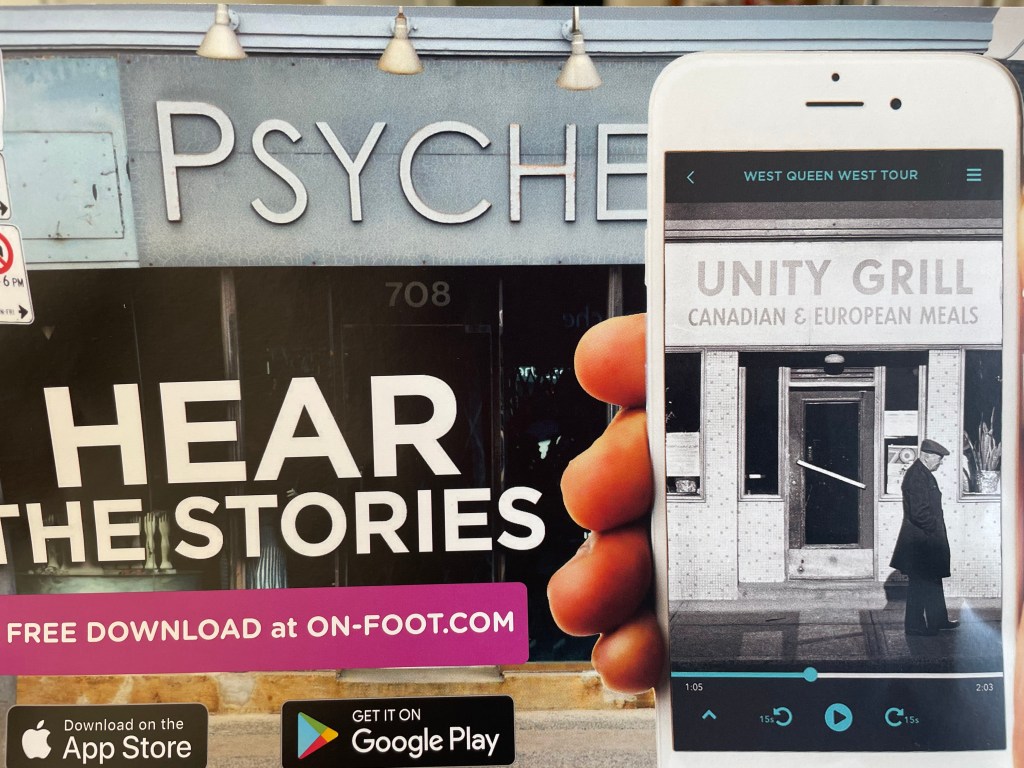
On-Foot Mobile App. Photo taken from Spacing: Toronto Urbanism Uncovered. 2021. #56.
Advantages of AR in the language learning library or classroom are outlined by Khoshnevisan and Le (n.d.) in their literature review on the subject. They include increased motivation, visual support, increased opportunities for interaction, and creating an authentic learning experience (Khoshenevisan and Le (n.d.). Motivation, authentic learning experiences and language scaffolding such as visual supports are integral to a successful language learning experience and if AR can help, it is worth learning more about.
Lastly, while AR offers opportunities for technology to enhance the physical world, another benefit to the language classroom is that it provides a real-world example and inspiration of what we see in science-fiction texts.

French graphic novels such as Roger et ses humains, in which Roger the robot is the main character who interacts with his human peers, as well as Voleurs d’espoir and Voleurs de mémoire, where characters can send their avatars into the network to explore and interact, play with ideas that are beyond our reach yet plausible given current technology.

Science fiction can inspire many important and fascinating discussions about technology, ethics, and philosophy that can support authentic and motivating conversations in a language classroom. AR in the classroom could inspire connections to reading and discussion themes in science-fiction literature or to ultimately imagining and creating their own science fiction stories.
Somme toute, I’m glad I donned the goggles and attempted a first dive into the waters of AR and VR. I turns out that much of AR has nothing to do with goggles at all, so I need not fear them! More importantly, it turns out AR is more aligned with foundational and innovative teaching practices, and that the potential of this technology to enhance learning in the language learning library and classroom make it worthy of a deep dive.
References
Green, Green and Brown (2017). Augmented reality in the K-12 Classroom. TechTrends (2017) 61:603–605.
HP Reveail: Créer de la réalité augmentée. Carrefour Education. Retrieved from https://carrefour-education.qc.ca/applications/hp_reveal
On-Foot Mobile App. Photo taken from Spacing: Toronto Urbanism Uncovered. 2021. #56.
Khoshnevisan & Le (n.d.). Augmented Reality in Language Education: A Systematic Literature Review . College of Education University of South Florida, United States. Retrieved from https://www.researchgate.net/profile/Babak-Khoshnevisan/publication/334223033_Augmented_Reality_in_Language_Education_A_Systematic_Literature_Review/links/5d1d60f7a6fdcc2462bdc16c/Augmented-Reality-in-Language-Education-A-Systematic-Literature-Review.pdf
 Technology in the language learning classroom and library